
Bitz.io Withdrawal Times, Fees and Limits 2026
 Available in US
Bitz.io
Cashout timing, limits and review
Bitz.io crypto payouts are typically described in the 15–60 minute range after approval, and an independent hands-on review recorded examples at 18 and 23 minutes. That short timing is only one layer of the cashout process: account review, identity checks, a deposit-wagering fee rule, monthly caps and large-win installments can matter before the blockchain transfer is complete.
Table of Contents
- The main Bitz.io withdrawal constraints
- Cashout constraint matrix
- Why 15–60 minutes is not the whole wait
- Minimums and monthly caps shape larger cashouts
- The 1× deposit rule can change withdrawal cost
- Risk-based verification can extend processing
- Large balances can face installment rules
- What to keep before and after requesting a payout
- Bitz.io withdrawal FAQ
- Fast crypto rails do not remove account-level cashout limits
- Bitz.io Payments, Deposits and Withdrawals 2026
The main Bitz.io withdrawal constraints
The quickest payout example tells you how fast a successful request can move; it does not tell you whether every request will be approved on the same path. Bitz.io combines blockchain payments with account-level conditions, so a useful withdrawal check separates minimums, review timing, fees, caps and identity triggers instead of compressing them into one “payout speed” number.
- Typical crypto payout15–60 minutes after approval
- Measured examples18 and 23 minutes
- Minimum withdrawalAbout EUR 10 equivalent per transaction
- Monthly capEUR 10,000, with a lower EUR 5,000 cap in a specified balance condition
- Extra fee rule8% with a EUR 4 minimum if deposit wagering is below 1×
- Large-win term$300,000 max win; $50,000+ may be paid in installments
The parent payments guide covers the full coin and network set. Here the focus is what happens once you want value to leave the account, because cashout friction comes from more than the selected blockchain.
Cashout constraint matrix
These constraints act at different stages. A minimum can block a small request, a review can delay an otherwise valid one, and a monthly cap can limit the amount released even when the selected network itself is functioning normally.
| Constraint | Known Bitz.io rule | Where it matters | What to check |
|---|---|---|---|
| Minimum withdrawal | About EUR 10 equivalent; examples around 5 USDT or 0.0002 BTC | Before request submission | Live value for the selected asset |
| Typical payout time | 15–60 minutes after approval | After account approval | Whether the request has actually been released |
| Extended review | Can reach 24 hours or longer during extra anti-fraud or identity checks | Before broadcast | Account messages and requested documents |
| Transfer fee | Applicable network fee | At blockchain transfer | Selected asset and network |
| Deposit-wagering fee | 8%, minimum EUR 4, may apply if the deposit has not been wagered at least 1× | Before cashout | Deposit wagering status |
| Monthly cap | EUR 10,000; EUR 5,000 when balance reaches 10× deposits | Across the month | Prior withdrawals and current balance condition |
| Large-win installments | Wins above $50,000 may be paid monthly; max win cap $300,000 | Large balances | Applicable account terms before planning a large cashout |
Why 15–60 minutes is not the whole wait
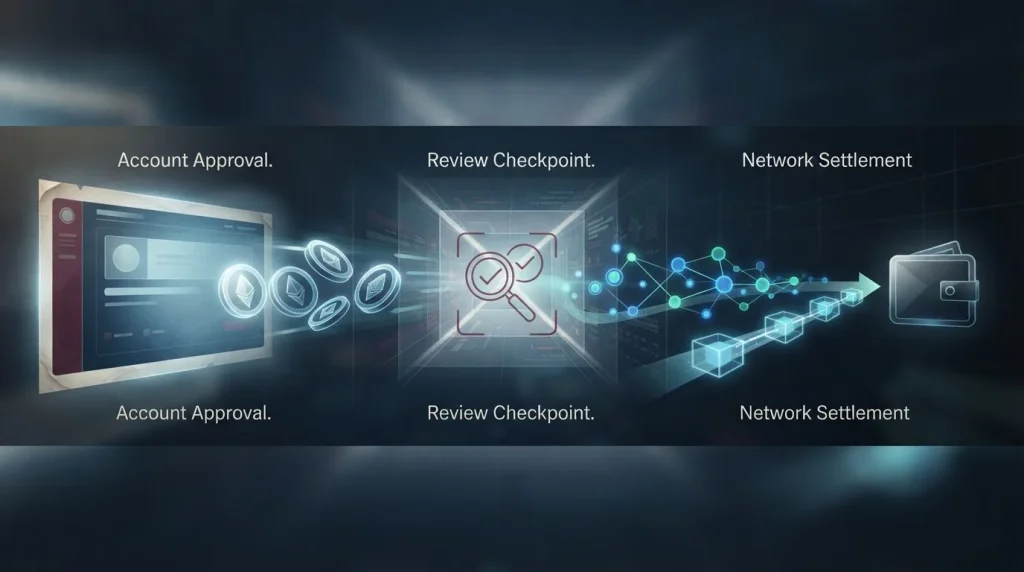
The reported 15–60 minute timing applies after approval. That wording matters. A request can spend time in account review before a blockchain transaction exists, and extra anti-fraud or verification checks can extend processing to 24 hours or longer.
Stage one is account approval
The casino checks the request against account, payment and risk conditions. If additional verification is triggered, the request can remain here even though the chosen blockchain is operating normally.
Stage two is blockchain broadcast
After release, the payout becomes an on-chain transfer. At that point a transaction hash can show whether the payment was sent and which network is carrying it.
Stage three is wallet credit
The receiving wallet or exchange can wait for its own confirmation threshold before showing the funds as available. That policy belongs to the receiving service, not to Bitz.io.
An independent hands-on review recorded 18- and 23-minute crypto payouts. Those examples show that a clean request can move quickly, but they should not be read as a guaranteed service level for every account or every withdrawal.
A practical troubleshooting sequence is simple: first check whether Bitz.io marks the request as pending or approved; then look for a transaction hash; finally check the destination wallet’s confirmation status. Each step answers a different question.
Minimums and monthly caps shape larger cashouts
The minimum withdrawal is roughly EUR 10 equivalent per transaction, with examples around 5 USDT or 0.0002 BTC depending on the asset and route. That is the small-balance constraint. Larger balances face a separate monthly limit.
- Small-request floor
- About EUR 10 equivalent per transaction.
- USDT example
- Around 5 USDT.
- BTC example
- Around 0.0002 BTC.
- Monthly cap
- EUR 10,000.
- Lower-cap condition
- EUR 5,000 once the balance reaches 10× total deposits.
Think of those as two independent checks. A EUR 6-equivalent request can fail because it is below the asset’s withdrawal floor, while a much larger request can be affected by the monthly cap even though it easily clears the minimum. The live cashier value is the sensible reference for the exact asset-specific floor before you submit.
The 1× deposit rule can change withdrawal cost
The operator’s terms include an additional fee condition: withdrawing before wagering the deposited amount at least once may trigger an 8% fee with a minimum charge of EUR 4. This is separate from the blockchain network fee.
A simple example shows why the distinction matters. Suppose a player deposits a reader-chosen amount and requests a cashout before the deposited funds have been wagered once. The network fee is the transfer cost associated with sending crypto; the 8% rule is an account-level condition tied to how the deposit was used. They can exist at the same time because they arise from different parts of the transaction.
- Check the deposit history and whether the deposited amount has been wagered at least once.
- Review the current withdrawal screen for the selected asset and network.
- Separate any account-level fee from the blockchain network fee when comparing the expected amount.
- If the displayed cashout amount does not match your expectation, resolve the account-level condition before sending another request.
If a deposit was tied to the welcome offer, the bonus has its own 50× wagering requirement. That is a different rule again; the bonus guide explains the turnover requirement separately from the 1× deposit condition.
Risk-based verification can extend processing
Bitz.io does not require mandatory upfront verification simply to start, but its account rules allow identity checks to be requested when risk, withdrawal or anti-money-laundering triggers arise. Those checks can include ID, selfie, proof of address and source-of-funds evidence.
Prepare information that matches the account
- Use account details that can be supported by your own documents if requested.
- Keep the wallet address and transaction hash connected to the deposit and withdrawal history.
- Respond to a specific document request rather than sending unrelated material.
Do not treat “no upfront KYC” as anonymity
- A withdrawal can still trigger a verification request.
- Source-of-funds checks can ask for more than basic identity evidence.
- A request under review can take longer than the typical post-approval payout range.
Complaint summaries around Bitz.io include verification and payout-friction disputes, so it is useful to assume that a cashout may require account evidence even if registration did not. That is a preparation point, not a prediction that every withdrawal will be checked.
Large balances can face installment rules
The published terms summarized in independent coverage include a $300,000 maximum-win cap, while wins above $50,000 may be paid in monthly installments. These are high-value account terms rather than ordinary blockchain limits.
The practical consequence is that a large displayed balance does not necessarily translate into one immediate on-chain payment. Monthly withdrawal caps and installment terms can both shape the release schedule, and they should be considered separately from whether the chosen coin is technically capable of moving quickly.
What to keep before and after requesting a payout
Good records cannot make a withdrawal faster, but they can make a delay easier to diagnose. Crypto transactions already produce useful identifiers; combine those with the account-side record instead of relying on memory or screenshots of a single balance.
- The selected withdrawal asset and network.
- The destination wallet address copied from your own wallet or exchange.
- The requested amount and the account status shown after submission.
- Any identity or source-of-funds request received during review.
- The transaction hash once the payout is broadcast.
- The receiving wallet’s confirmation status if the transfer is on-chain but not yet credited.
The corresponding deposit-side checks are covered in the Bitz.io deposit guide. Keeping both sides of the flow — incoming transaction and outgoing cashout — makes it easier to separate wallet problems, account review and blockchain settlement.
Bitz.io withdrawal FAQ
How long do Bitz.io withdrawals take?
Typical crypto payouts are 15–60 minutes after approval, and hands-on examples were recorded at 18 and 23 minutes. Extra anti-fraud or identity review can extend processing to 24 hours or longer, so the shorter range is not a guarantee from the moment you submit a request.
What is the minimum Bitz.io withdrawal?
The minimum is about EUR 10 equivalent per transaction, with examples around 5 USDT or 0.0002 BTC depending on the asset and network. Check the live cashier value before requesting a payout.
Does Bitz.io charge a withdrawal fee?
The crypto transfer carries the applicable network fee. The operator’s terms also state that withdrawing before wagering the deposit at least once may trigger an 8% fee with a EUR 4 minimum.
Does Bitz.io have a monthly withdrawal limit?
The stated monthly cap is EUR 10,000, falling to EUR 5,000 once the balance reaches 10× total deposits.
Can Bitz.io ask for KYC before paying a withdrawal?
Yes. There is no mandatory upfront verification simply to start, but identity, selfie, proof-of-address or source-of-funds checks can be requested during a withdrawal, risk review or anti-money-laundering check.
Fast crypto rails do not remove account-level cashout limits
Bitz.io can process straightforward crypto payouts quickly, and the 18- and 23-minute measured examples sit inside the broader 15–60 minute post-approval range. The important qualification is everything that can happen before broadcast: risk-based verification, the 1× deposit fee condition, monthly caps and installment terms for large wins. Check the live asset minimum, keep account and blockchain records separately, and treat payout speed as one part of the withdrawal process rather than the whole process.